Back to Research
Lab-Feedback AI Modeling
Adaptive systems that continuously improve predictions and respond to emerging threats
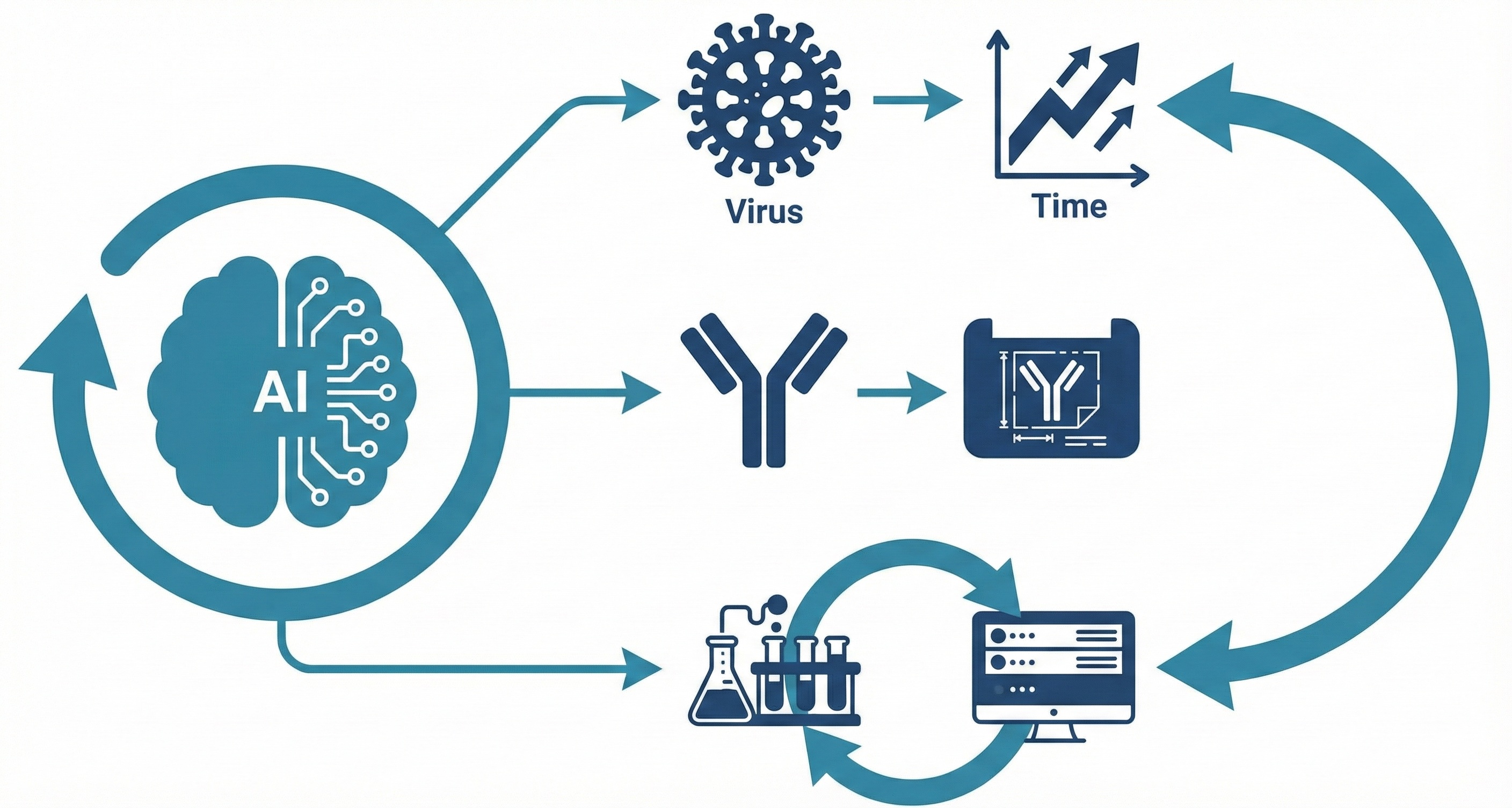
Overview of the lab-feedback AI modeling cycle
Core Components
-
High-Throughput Screening: High-throughput screening of antibody-antigen interactions.
-
AI Modeling (Foundation Models): Large-scale foundation models for virus evolution and antibody design that continuously improve through feedback loops.
-
Continuous Model Refinement: Systematic processes for updating models based on experimental validation and performance metrics through .
The Feedback Process
The lab-feedback cycle operates as a continuous loop: high-throughput experiments generate new data about viral behavior and immune responses, which AI systems analyze to identify patterns and discrepancies. Based on this analysis, new hypotheses are generated and AI models are updated with refined predictions. This iterative process enables rapid adaptation to emerging viral threats and continuous improvement in antibody design.