Overview of the MUSE program
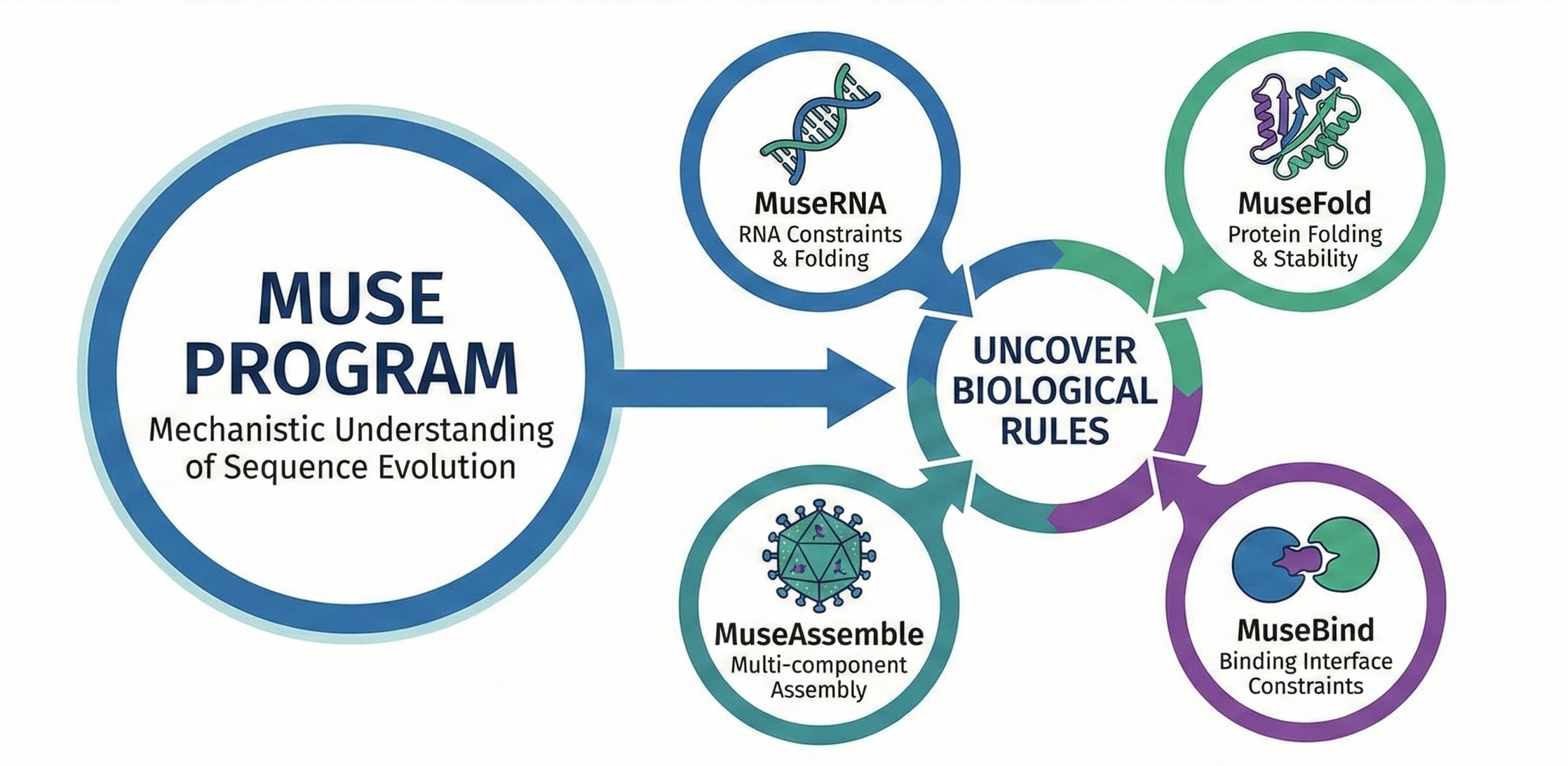
The MUSE program (Mechanistic Understanding of Sequence Evolution) is a family of foundation models designed to uncover the biological rules governing sequence evolution across RNA, protein, and multi-component molecular systems. Unlike traditional predictive models that focus solely on outcomes, MUSE models are explicitly trained to reveal why certain mutations or sequence changes are tolerated, deleterious, or compensable, providing mechanistic insight into molecular constraints.
The MUSE Model Series
The MUSE program includes four core models, each designed to capture different aspects of molecular evolution:
MuseRNA
Learns RNA structural and interaction constraints to explain how mutations impact folding, stability, and functional interactions.
MuseFold
Captures protein folding, stability, and epistatic effects to elucidate structure-function principles.
MuseAssemble
Models the rules governing multi-component assembly, including viral genome packaging and oligomer formation.
MuseBind
Learns binding interface constraints to explain molecular recognition and interaction specificity.